5.1.- Shuttle & Commander
marca

Bedside and ambulatory monitoring of 12-LEAD ECG, SpO2 and non-invasive blood pressure
5.- TELEMEDICINA
5.1.- Shuttle & Commander
marca
Bedside and ambulatory monitoring of 12-LEAD ECG, SpO2 and non-invasive blood
pressure
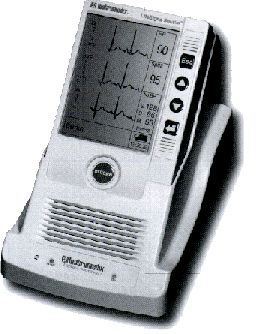
The shuttle and the
Commander team up for a breaktrough in telemedicine by delivering hospital grade vital
signs monitoring for the patient at home. These two components of the LifeSigns System
enable rapid access to information necessary for managing patients more eficiently after
shortened hospitalizations. Incorporated in this leading-edge technology are propietary
advanced communications capabilities which allow transmission of the vital signs data to
the LifeSigns Central Station.
The Shuttle records and displays vital signs information including
12-lead ECG, blood oxygen saturation (SpO2) and when used with the Commander, non-invasive
blood pressure (NIBP). this patient-worn monitor can be programmed to record vital signs
periodically, on demand or automatically if specific vital limits ara exceeded.
The Shuttle can store up to 20 recordings before it is necessry to
transmit the information to the Central Station, a computerized patient manager system. A
single recording consists of one 12-lead ECG; up to 60 seconds of three-lead ECG,
retrograde or antegrade; SpO2; and blood pressure. The commander serves as a transmission
link in the chain of communications between the Shuttle and the Central Station and also
provides the non-invasive measurement of the blood presure. When placed in the Commander,
the Shuttle automatically dials the receiving facility and through the Commander's
built in modem, downloads the vital signs information to the Central Station.
A hands-free simultaneous voice connection between patient and the
monitoring facility is archieved during data transfer to the Central Station. This enables
communication using a standard telephone line between patient and clinician while the
transmission is being received and displayed. Patient comfort, peace of mind and
compliance are archieved.
5.2.- Central Station
marca
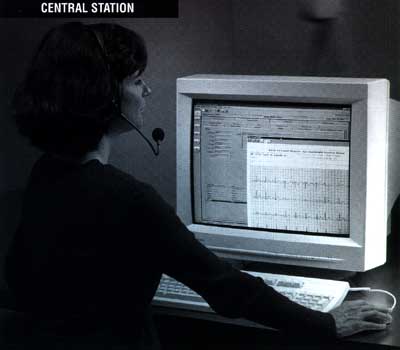
At the heart of the
LifeSigns Shuttle is the Central Station. As part of a powerful patient management system,
it contains complete medical profiles for expedient review and analysis on-screen. Patient
reports and vital signs data can be sent by fax for inmediate physician evaluation.
The Central Station receives, organizes and stores vital information recorded in an
out-patient setting. The patient at home, for example, who is monitored with the LifeSigns
Shuttle can record and store such vital information as 12-lead ECG, SpO2 and blood
pressure. At any time during the prescribed monitoring period, these vital signs can be
automatically downloaded to the CentralStation through a telecomunications port called the
LifeSigns Commander. A built-in modem provides for continuous voice contact between
patient and the attendant at the Central Station while the vital data is received at the
Central Station, comparison and assessment are easy and quick to enable early response to
changes in patient status. In addition to 12-lead ECG, SpO2 and blood pressure, the
patient record is readily accessible on-screen and includes history and physical
assessment, allergies, medications, therapies and progress notes. Current and previous
physician orders can be displayed on one screen for convenient reference.
Using the intuitive Windows interface, file cabinets, tabs and comment fields
open up an array of options. Patient profile and assessment reports are accessed with a
single click so that historical and current information can be viewed simultaneously and
printed.
Another measure of the system's efficiency is ability to generate individual
and batch reports.
The Central Station streamlines patient management through state-of-the-art
technological advances which deliver an incomparable level of efficiency and cost-savings
to the healt care network.